

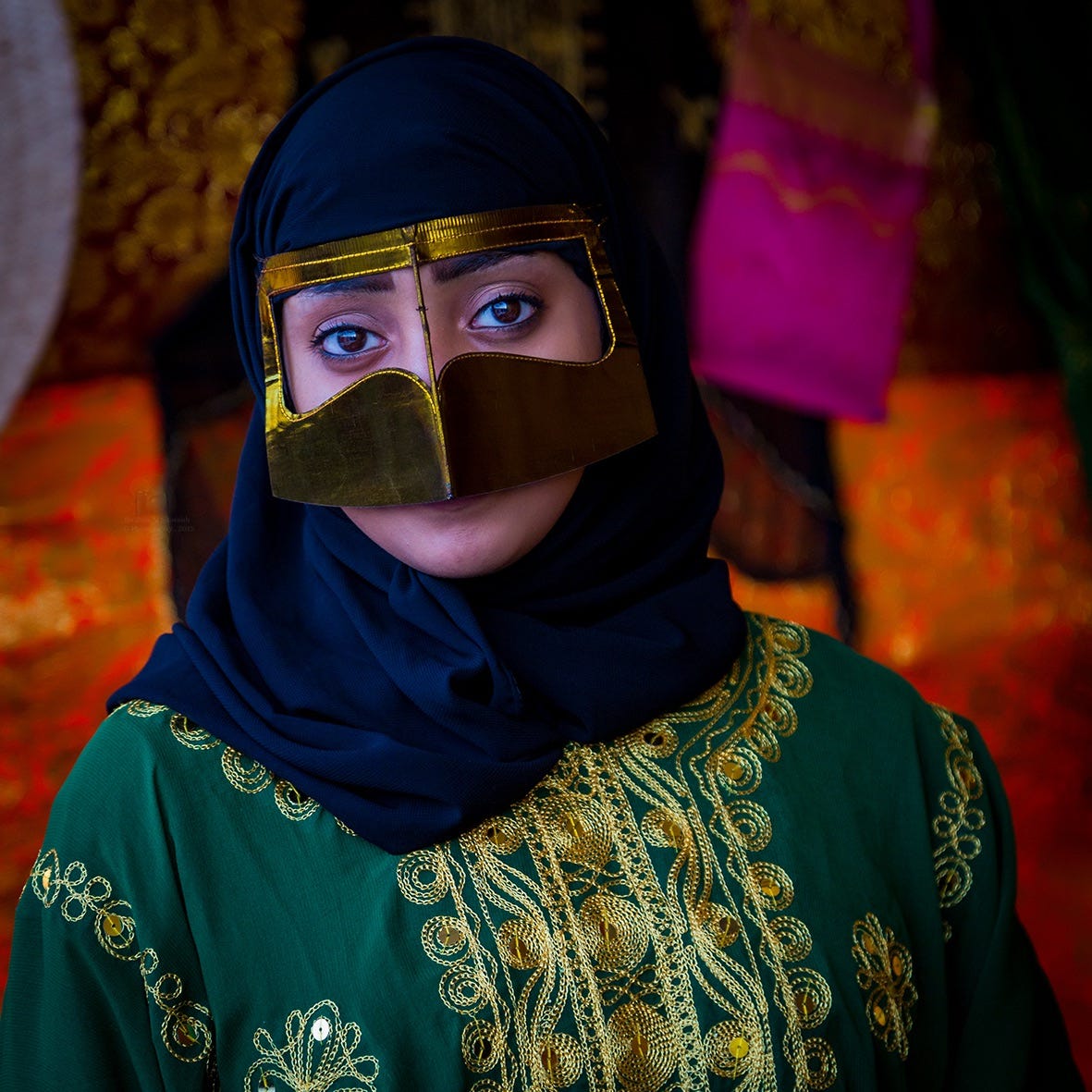
Long before oil wealth, nation-states, and global fashion cycles reshaped the Gulf, women across its coastal societies wore a garment that translated cultural identity into form: the battoulah, also known as the burqa’. Neither jewelry nor veil in the modern sense, it was a rigorously coded object — one that shaped how women were seen, signaled social position, and anchored them within a shared visual order understood across the region.
Trade, Textiles, and the Making of a Gulf Form
The battoulah emerged from the maritime cultures of the Gulf, shaped by centuries of exchange across the Indian Ocean world. From at least the early modern period, Gulf ports were linked to India, Persia, East Africa, and southern Arabia, importing textiles, dyes, and techniques that women adapted locally. Despite its metallic appearance, the battoulah was not typically fashioned from solid gold. It was constructed from stiffened cotton or silk, dyed — often with indigo or other natural pigments — and treated to achieve a reflective surface in tones of gold, bronze, or copper. Its sheen reflected textile knowledge rather than raw material wealth, and its durability made it suitable for daily wear.
By the eighteenth and nineteenth centuries, variations of the battoulah were widespread across what are now the United Arab Emirates, Oman, Bahrain, Kuwait, Qatar, parts of eastern Saudi Arabia, and the southern Gulf coast of Iran. It was not an imported curiosity but a locally standardized form, maintained, transmitted, and refined by women themselves.
Form as Geography — Regional Languages of the Battoulah
The battoulah was never singular. Its authority lay in variation. Shape, proportion, and finish differed from place to place, forming a visual language legible to those within it.
In the Emirates, styles tended to be narrow and sharply contoured along the nose, often finished in bright, polished gold tones. Omani versions were frequently broader and longer, sometimes extending toward the chin, echoing older South Arabian influences. In Bahrain and Qatar, forms often appeared squarer, marked by a pronounced upper panel, while Kuwaiti examples historically favored darker metallic hues and softer edges. These distinctions were not incidental. The battoulah functioned as geographic literacy, locating a woman within the Gulf’s social landscape without a word being spoken.
Social Meaning — Womanhood, Authority, and Visibility
Traditionally, the battoulah was not worn by girls. Its adoption marked a transition — most commonly marriage or adulthood — and with it a shift in social standing. To wear the battoulah was to be recognized as a woman with responsibilities, boundaries, and authority.
Crucially, it was not simply about concealment but about structured visibility. It framed the eyes, disciplined the face, and projected composure, allowing women to move through public life while commanding respect. In many communities, it was considered beautifying, lending gravity rather than anonymity. Among elder women especially, it became an emblem of experience and presence.
Craftsmanship carried meaning as well. Finer fabric, deeper color, and precise tailoring quietly communicated family standing and personal refinement, operating within an ethic that valued restraint over display. The battoulah did not shout status; it encoded it.
Transformation and Reinterpretation
The mid-twentieth century brought rapid transformation. Urbanization, expanded educational and professional roles for women, the spread of alternative veiling practices, and the influence of global fashion gradually displaced the battoulah from everyday life. Yet it did not vanish. Instead, it shifted registers, moving from daily garment to symbolic object.
Today it appears in museums, national celebrations, weddings, heritage festivals, and contemporary art. Designers reference it, photographers restage it, and institutions curate it as evidence of continuity. This evolution reflects not only loss but reinterpretation. The battoulah has become a site where questions of gender, memory, and authenticity are negotiated.
Reading the Battoulah Correctly
Contemporary encounters with the battoulah often reduce it to spectacle — a “metal mask” flattened into heritage imagery or aesthetic curiosity. Such readings miss its function. Historically, the battoulah was not decorative excess but social precision.
It organized the face without erasing it, asserted modesty without anonymity, and enabled women to move through public life while remaining legible to those who understood its codes. In a region where lineage, place, and reputation carried weight, it operated as a disciplined visual system — learned, maintained, and transmitted by women themselves.
What disappears when the battoulah is reduced to costume is not just a tradition, but a way of reading the world. Its shapes mapped the Gulf before contemporary political borders did. Its materials reflected trade networks rather than trends. Its authority emerged not from doctrine, but from practice.
To encounter the battoulah today — on the face of an elderly woman or behind museum glass — is to confront evidence: evidence of a culture that understood adornment as social intelligence, and of women who authored that intelligence deliberately and in full view.