
Sam Maloof — The Untrained Artisan Who Revolutionized American Studio Furniture
By Ralph I. Hage, Editor

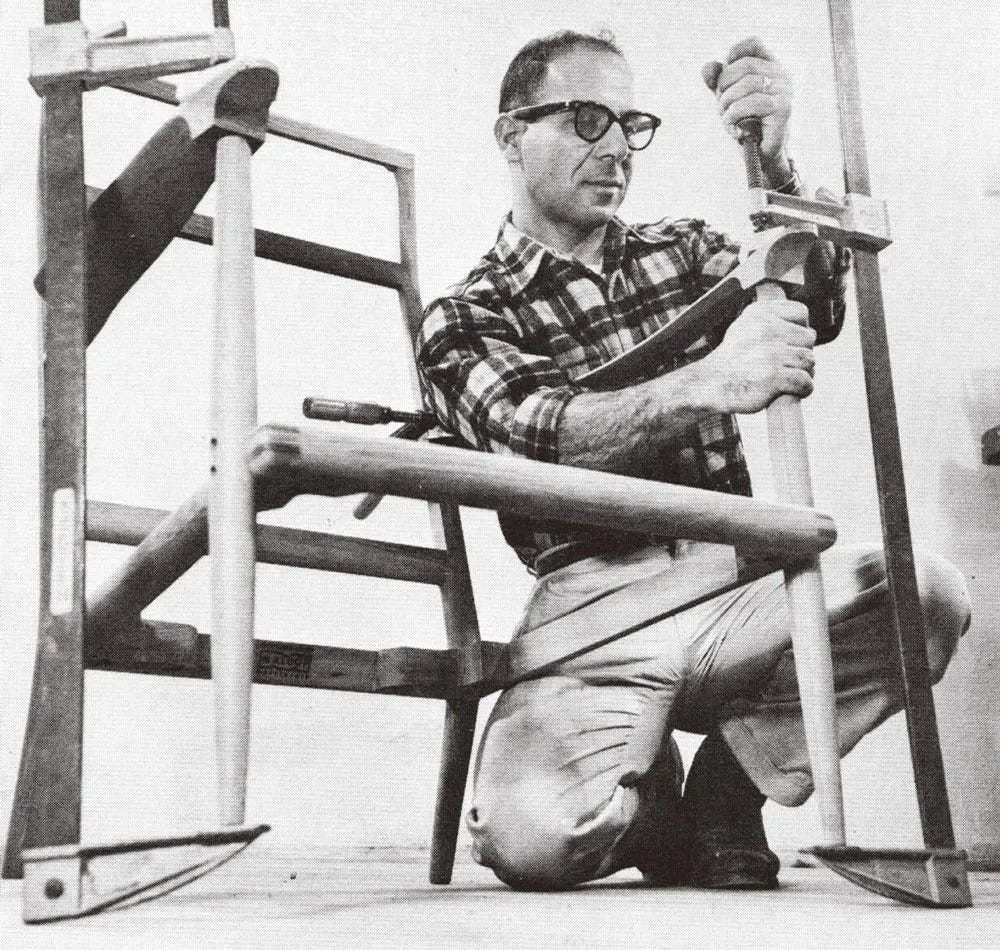
As for schooling, my clients are my teachers. They’re the ones who bring me the design problems. Schools get too easily divorced from the real world. In many places students graduate and become teachers without ever making a living from their work. They grow stale. There’s a preciousness I see in a lot of student work that comes from having too many hours to put into it. Perfection is fine, and nothing has left my shop that I’m not proud of, but you have to produce if you are going to make a living. I’ve heard people say they have to put a piece of wood aside until the spirit hits them. That’s procrastination. Pick it up and work it – you’ll feel the spirit. No, I think it’s an advantage being self-taught.
— Sam Maloof, December 1980, Fine Woodworking
In the history of mid-century American design, studio furniture makers generally divided into two camps: those who prioritized experimental art, and those who focused on functional production. Sam Maloof managed to bridge this divide. Over a fifty-year career, he established a workshop model that emphasized batch-production quality, ergonomic utility, and distinct joinery, influencing the trajectory of American studio craft.
Born in Chino, California, in 1916 to Lebanese immigrant parents, Maloof did not attend formal design schools. He spoke Arabic at home and learned basic construction skills through domestic necessity. Following his service in the U.S. Army during World War II, Maloof began building furniture for his home using surplus materials and salvaged dunnage. By the early 1950s, this utilitarian hobby transitioned into a full-time commercial enterprise as regional demand grew for his custom hardwood designs.
Design Mechanics and Woodworking Technique
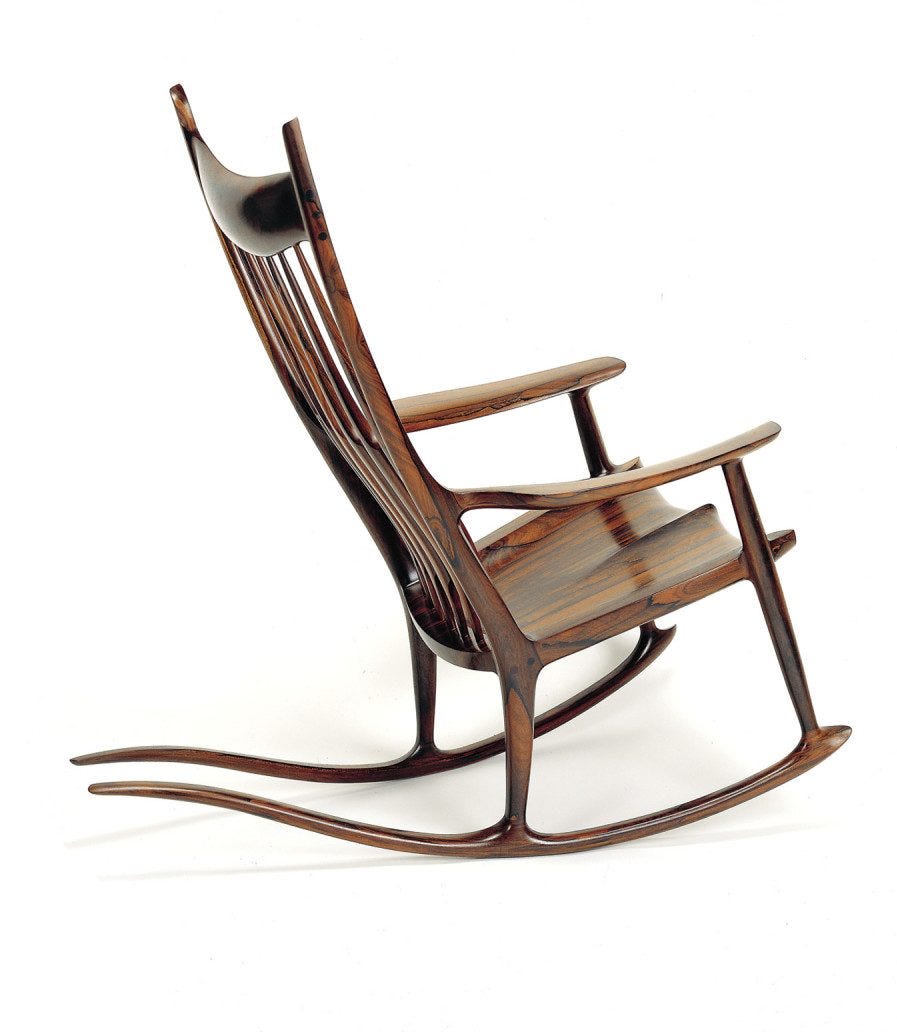
Maloof’s furniture is defined by its rounded joints and hardline geometry. While contemporary mid-century designers utilized molded plywood and industrial plastics, Maloof worked almost exclusively in American hardwoods, particularly black walnut.
His production relied heavily on a band saw to rough out shapes, followed by extensive hand-shaping using rasps and scrapers. The distinctive aesthetic of his chairs comes from the joinery: he used a modified tongue-and-groove joint reinforced with long wood screws, which were then hidden by matching wooden plugs. This method allowed him to shave down the wood where the leg meets the seat, creating a smooth transition that became a visual hallmark of his work.
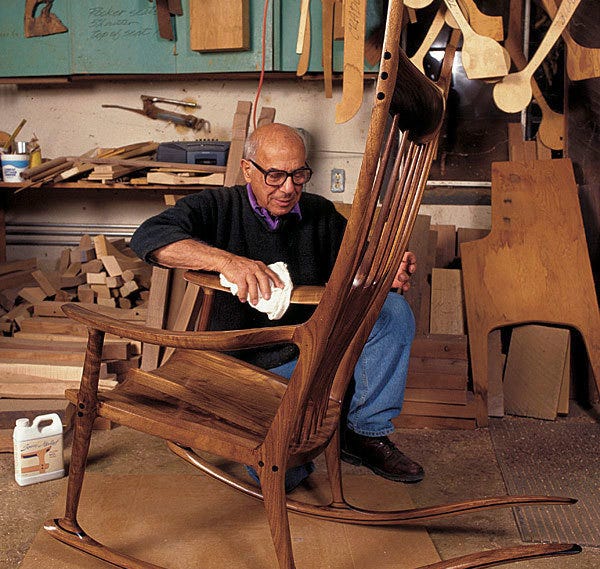
Ergonomics dictated his proportions. Maloof did not use formal blueprints; instead, he relied on prototype templates and adjusted measurements based on the physical feedback of the sitters. His rocking chairs featured elongated, curved runners that distributed weight evenly to prevent tipping while maintaining a low center of gravity.
Business Model and Production Ethos
Despite his rising profile in the 1970s and 1980s, Maloof rejected mass production or licensing agreements. He maintained a small workshop in Southern California, employing a few assistants to rough out components while he handled the final shaping, assembly, and oil finishing.
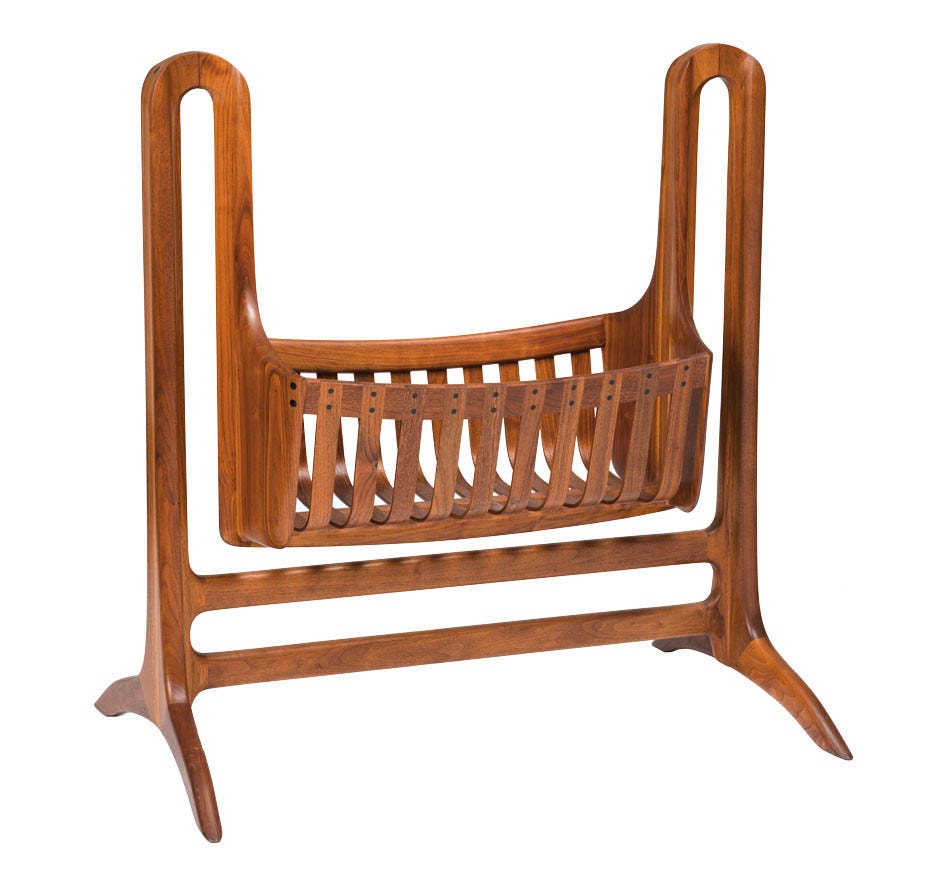
This small-scale approach created a backlog, with waiting lists often extending several years. To manage production, Maloof prioritized orders based on immediate human utility rather than client prestige; for example, orders for infant cribs were systematically moved to the front of the queue to ensure delivery before birth.
He resisted the label of “artist,” consistently listing his occupation on tax documents and business cards simply as “woodworker.” This distinction reflected his belief that furniture should be judged by its utility and structural durability rather than its conceptual value.
Institutional Recognition and Legacy
Maloof’s insistence on manual production did not limit his institutional reach. In 1985, he became the first craftsman to receive a MacArthur Fellowship. The award marked a shift in how major American museums viewed studio craft, validating furniture-making alongside fine arts.
His pieces were acquired by major permanent collections, including the Smithsonian American Art Museum, the Metropolitan Museum of Art, and the Museum of Fine Arts, Boston. His rocking chairs were also selected for the White House Craft Collection during the Carter administration and remained in use across subsequent presidencies.
The historic Maloof home and workshop compound in Alta Loma, California, which he expanded by hand over several decades, is now a California Historical Landmark. Managed by the Sam and Alfreda Maloof Foundation for Arts and Crafts, the site functions as a museum and an educational center for wood design. For the global Lebanese diaspora, Maloof’s career serves as a case study in how traditional manual precision and disciplined workshop management can establish a lasting footprint in modern international design.