

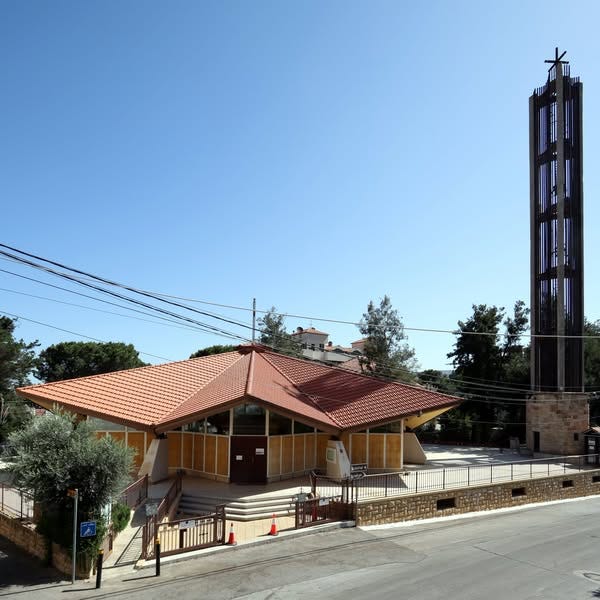
Rising above the wooded slopes of Broummana, Saint George Orthodox Church — known locally as Mar Jirjis — stands as one of the most compelling expressions of Lebanese sacred modernism. Rebuilt in 1962 on the foundations of an 1880 church, the structure reflects a moment when Lebanon was confidently participating in global architectural experimentation.
Designed by architect Samir Khairallah, the church departs radically from traditional ecclesiastical typologies. Instead of the basilica or conventional dome, it adopts a folded, octagonal concrete shell that rises like a vast tent over the hilltop. The gesture is both structural and symbolic.
Star Cast in Concrete
The roof forms an eight-pointed star — a folded octagonal dome articulated through reinforced concrete planes. Eight external columns connect to the roof through iron joints, absorbing expansion, contraction, and seismic movement. Structurally expressive, the design eliminates interior supports, creating an unobstructed nave that enhances both visibility and acoustics.
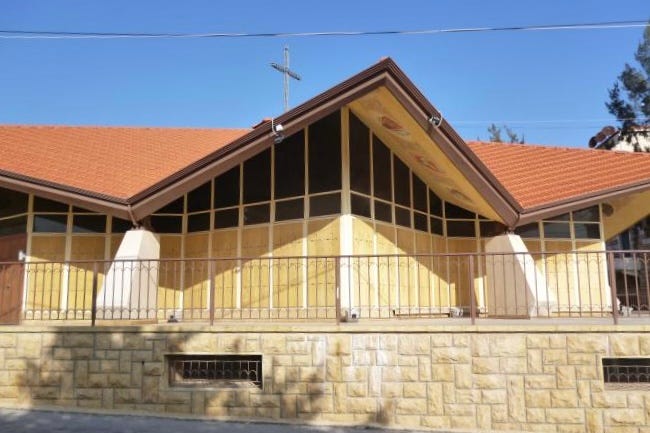
The columns are pushed outward, allowing the sanctuary to unfold as a unified volume. Upon entering, the entire spatial composition is immediately legible, the eye drawn upward to the dome’s axis where Christ Pantocrator presides.
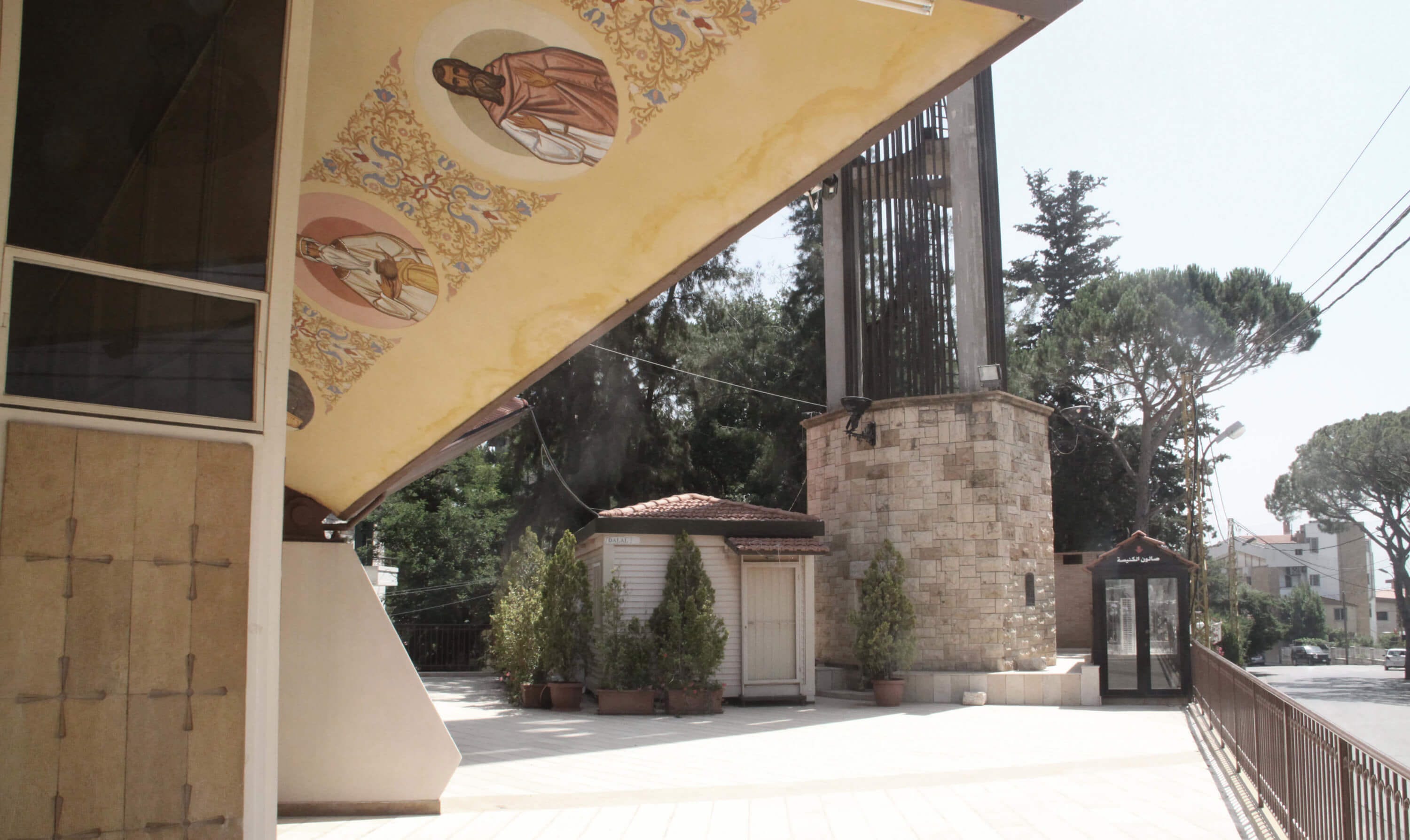
Light filters through the faceted geometry and large glazed façades, causing the star overhead to reflect onto the floor as a luminous cross. Structure, symbol, and theology converge in a single architectural gesture.
Echoes of Félix Candela
The church’s daring concrete geometry invites comparison with the work of Félix Candela, the Spanish-Mexican master of thin-shell structures whose churches and civic buildings transformed mid-century concrete design.
Like Candela’s experimental shells — particularly the dynamic forms of Los Manantiales—the Broummana church expresses structure as geometry. Its faceted roof recalls the folded surfaces and tent-like ecclesiastical spaces seen in Candela’s Mexican churches.
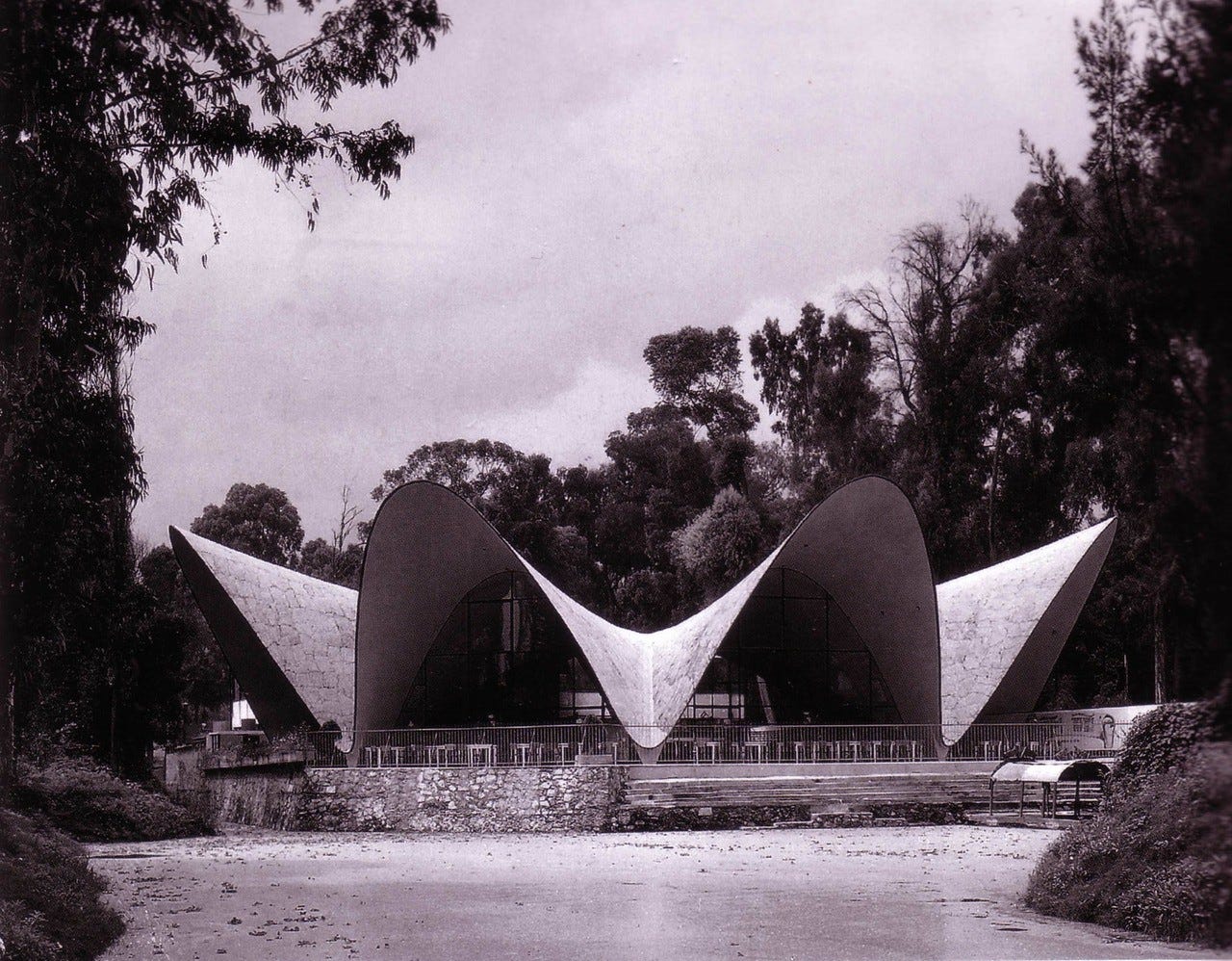
While Khairallah’s design does not employ pure hyperbolic paraboloids, it shares Candela’s core principles. Concrete becomes sculptural surface. Structural daring is rendered visually light. Geometry functions as spiritual metaphor. An economy of material achieves unexpected spatial grandeur.
The resemblance suggests that Lebanon in the 1960s was not architecturally peripheral but actively dialoguing with international modernism. The Broummana church stands as local evidence of a global structural revolution translated into a Lebanese idiom.
Byzantine Cosmos, Modern Shell
If the exterior speaks the language of mid-century engineering, the interior returns to Byzantine cosmology. The dome’s iconographic program follows the traditional Orthodox hierarchy: angels, prophets, apostles, and saints orbiting Christ.
Painted in the 1980s by Romanian priest-artist Sofian Boghiu and collaborators, the murals unfold the divine economy of salvation — from Abraham’s theophany to the Resurrection and Pentecost — culminating in the promise of the heavenly banquet.
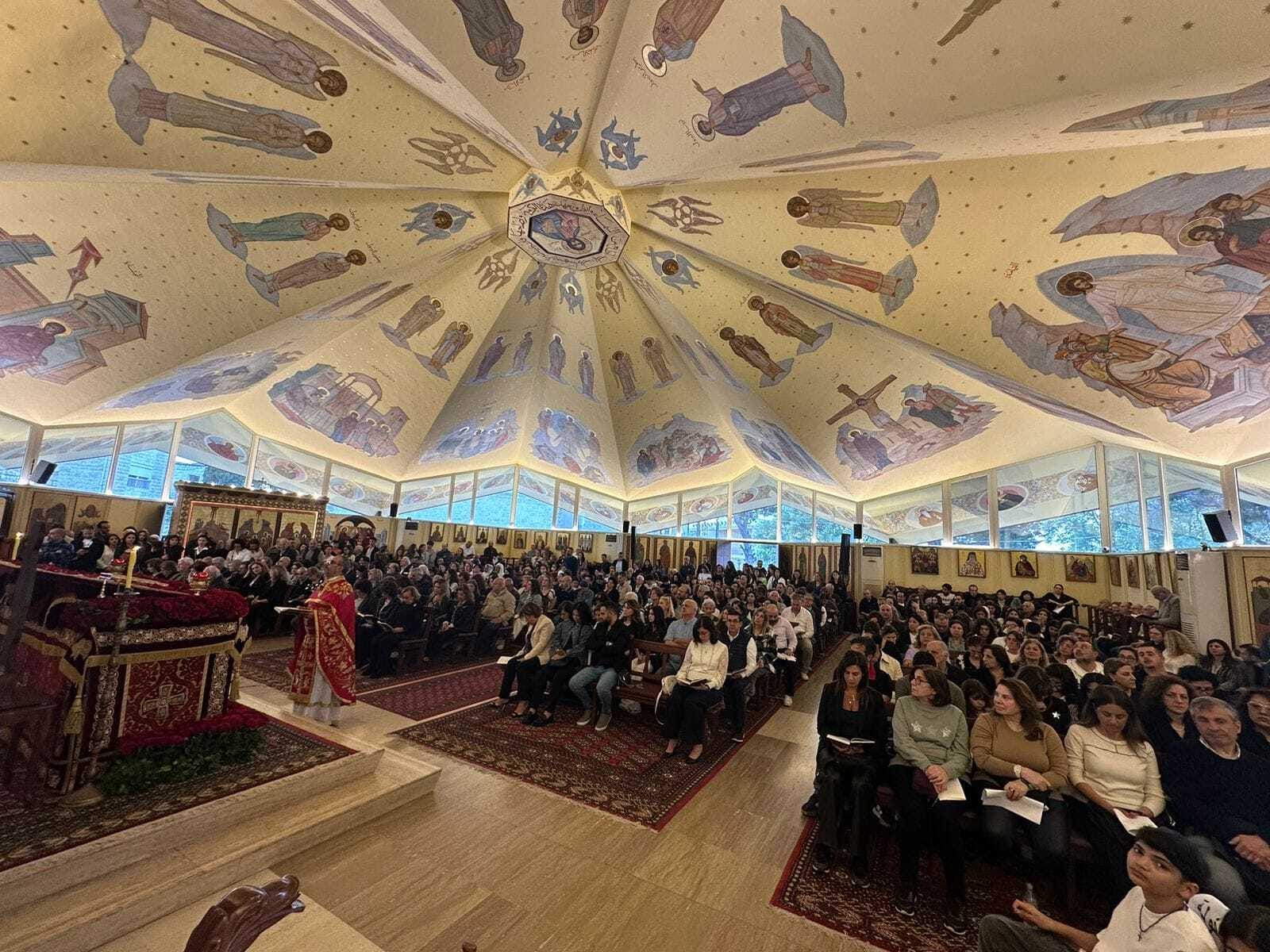
The result is a rare synthesis: modernist structure, Byzantine theology, and Lebanese landscape brought into harmonious coexistence.
The Old and the New
The 1962 church replaced an earlier structure known as “Al-Maskoubiya,” financed in part by Tsarist Russia. Its marble iconostasis dating to 1883 was preserved and expanded to suit the larger modern sanctuary.
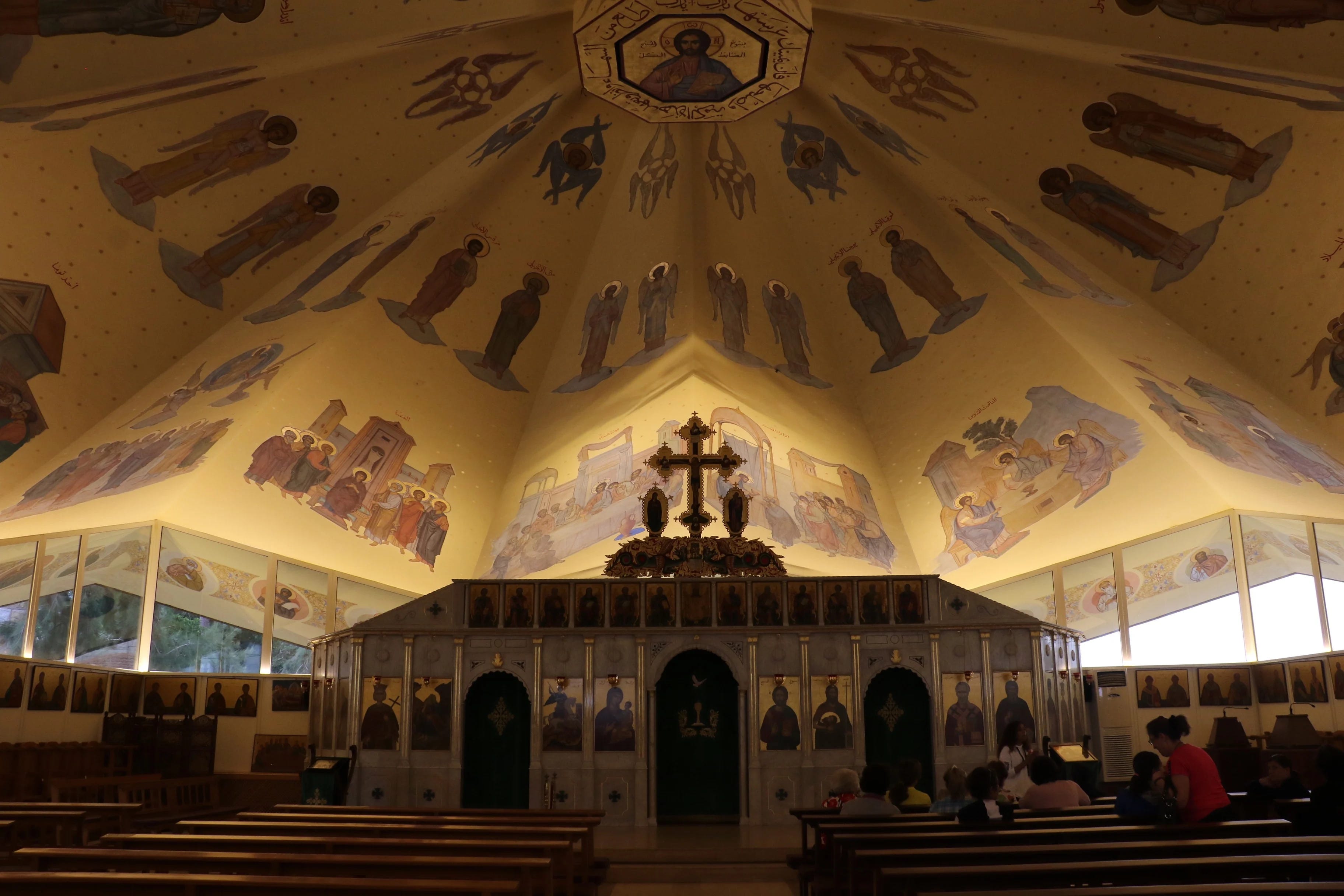
This stratification of eras embodies echoes of Lebanon’s layered history itself: Ottoman echoes, Russian patronage, post-independence modernism, and global artistic collaboration converging in a single sacred space.
Tent on the Hill
Seen from below, the church resembles a vast pavilion anchored to the earth yet poised to lift. The 40-meter bell tower, composed of three parallel vertical beams, reinforces the upward thrust and gives the complex a striking vertical counterpoint to the horizontal spread of the roof.
More than a parish accommodating 500 worshippers, Saint George Church is an architectural statement — a Lebanese interpretation of sacred modernism that remains largely undocumented in international architectural discourse.
In the geometry of its star-shaped roof, Broummana holds one of Lebanon’s most understated modernist treasures.