

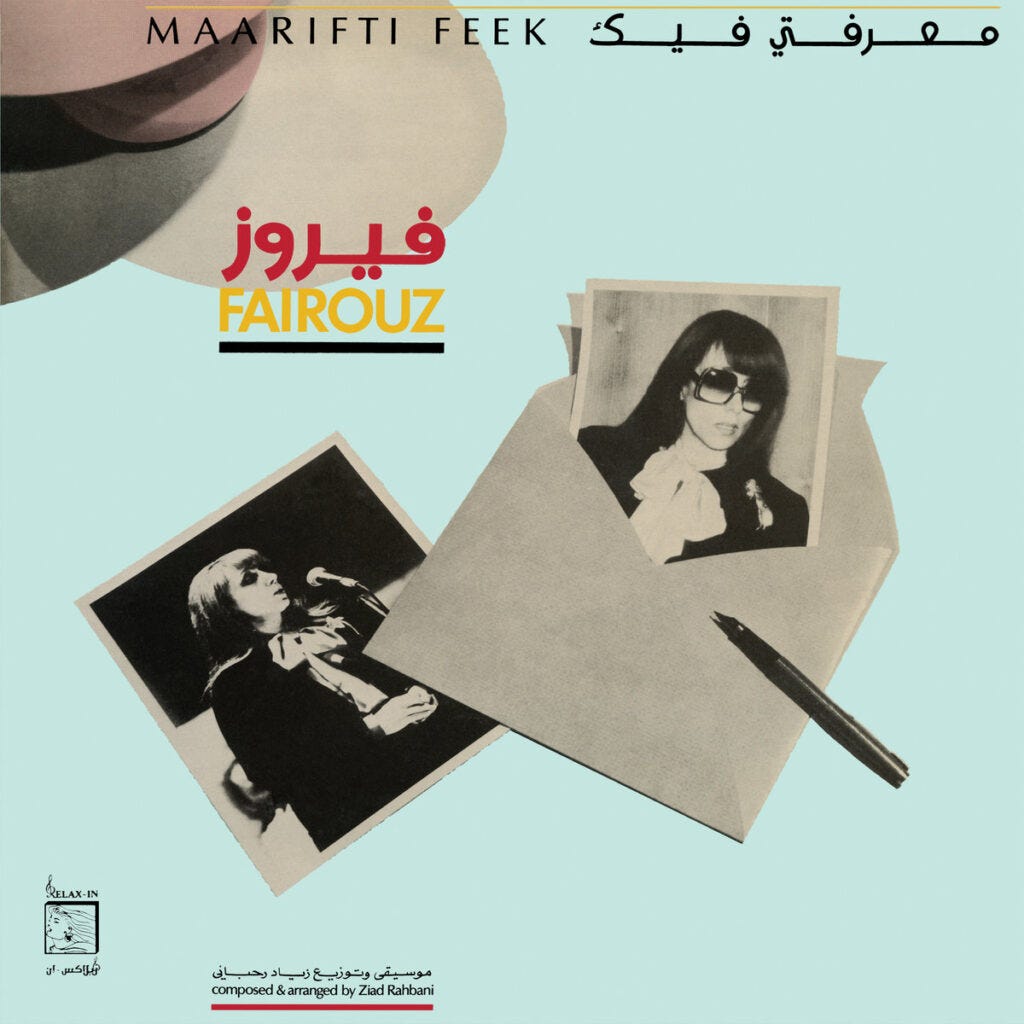
While going through my father’s vinyl collection, the care and intention behind the visual art and design of certain album covers become immediately apparent. Among them are local releases whose aesthetics feel strikingly modern and ahead of their time. Though they depart from traditional Lebanese visual language, they remain unmistakably Lebanese in spirit.
Sleek and restrained, Fairuz’s Maarifti Feek reflects a dialogue between East and West, with Latin and Arabic scripts placed in quiet harmony. In contrast, Khaled El Habre’s Madih Al Zol Al Ali offers a more unconventional approach: a three-dimensional rendering of Beirut layered with yellow and red shadows over a two-dimensional city map. Both covers were designed by Leila Musfy, Chairperson and Professor in the Architecture & Design Department.
Musfy sat with me to reflect on her years designing for singers such as Fairuz, musicians including Ziad Rahbani and Khaled El Habre, and actors such as Antoine Kerbaj.
-
Where Did You Study?
I did one year at AUB – Fine Arts, and then it closed in 1975. When they closed the program, I went to the States, to the Kansas City Art Institute in Missouri – this is where I got my Undergraduate Degree (BFA), and then I did my graduate work at Cranbrook Academy of Art where I got my MFA in Design in ‘81. I then moved to Washington D.C. and worked there for two years.
Do You Come From An Artistic Family?
Yes and no, but I started taking art lessons since I was eight or nine. Like all little girls, I was put in ballet school where I used to learn ballet. There, they used to give painting lessons and there were the greatest people teaching like Omar Onsi, one of the masters of painting. He used to give lessons there so I used to run away from ballet class and watch the painting class. Eventually my parents finally got convinced, moved me to painting, and stopped ballet. I started very early and then I took lessons with Helen Khal, then by Aref Rayess, and many other people. And once I finished high school that was it; it was art and that’s it. As for family, my father studied business, but he wrote wonderful poetry and played a little bit of music. On my mom’s side, my cousin is a well-known artist in the states, he is a book-maker, artist, writer, and designer. So it does exist in the family. Afterwards, I went to the States, learned what design was, made a choice that art was for me, and that design was to be my profession – that it would be my bread and butter.
When You Came Back To Lebanon From The USA, You Ended Up Working With Many Notable Artists. How Did You Enter That Scene?
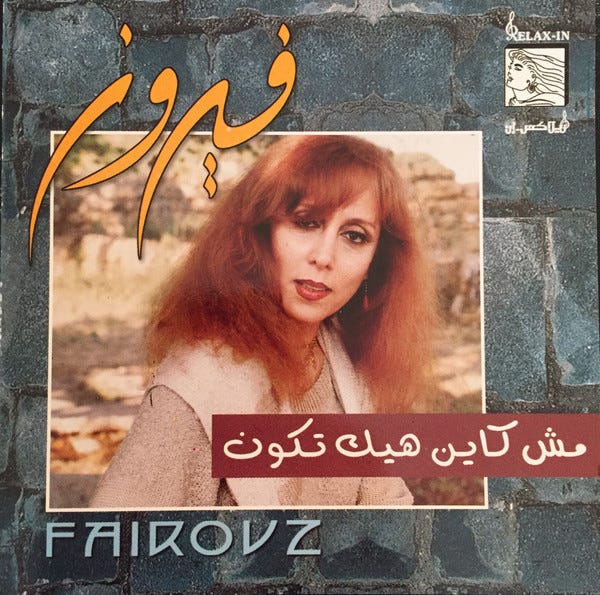
By accident, probably! I had worked in the States with a woman called Violet Yaacoub and she planned Fairouz’s big USA tour in 1981 – at that time I worked with her on the album cover for Fairouz’s “Hawa Beirut” USA Tour among other things, but Violet eventually had financial issues with the record so it never got distributed – there were only 500 copies printed of it.
And then when I came back to Beirut, Violet came and stayed at my house. At that point, Ziad was in the middle of his “Shi Fashel” play, and I was going with my father, but he gave his ticket to Violet, and she wanted to talk to Ziad to create a project together. After the play, we went backstage and met him, and Violet was a very funny person, a very wonderful person with a heavy English accent being somewhere between Iraqi-American English, and Ziad just couldn’t understand a word. When she said something he’d look at me and ask, “Shou 3am bit ‘oul? Shou 3am bit ‘oul?” and I would translate for him. So that was my first encounter with him. And then I became friends with Emile Boustany and Abboud El Saadi, who used to play with Ziad, so I went to the studio and started working with him. I started doing album covers and all that was needed design-wise, at the time I even did the mixer chart [or legend] manually. And through him, I started meeting all the other musicians, like Toufic Farroukh, Sami Hawat, Joseph Sakr, Ibrahim Jaber, and everybody that was hanging out during those days in the studio over there. Except Fairouz – you never meet her.
Did Politics Ever Play A Role In Your Design?
To me, it was never about politics. At that time, in that period in particular, there was nothing in design. There were no designers – I was a lone hand clapping. And then you had this very high end form of art which was music, and Ziad Rahbani was at the forefront, and everything that he represented was rebellion and trying new things.
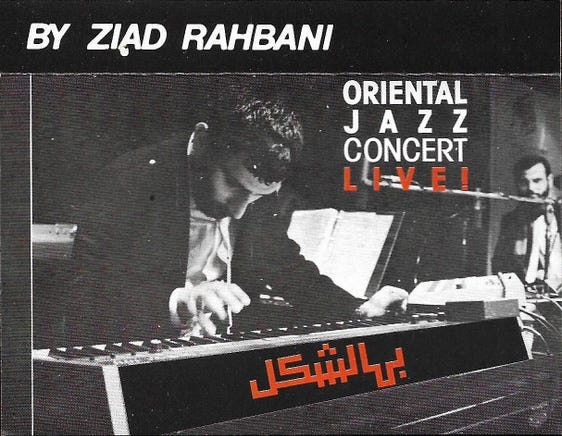
When I think back, what really made me click with him was not him appreciating my design or vice versa. It was him and I, doing the same things, in our own fields, in our own way – the amalgam of East-West. Him doing the Oriental-Jazz and trying to mix the language of music of East and West, and that’s what I was doing in design. My whole quest was always this parallel between Arabic and Latin in typography and experimenting and I tried as early as the early ‘80s to do this. It wasn’t really about design either, it was about the whole environment. Being with people that were so highly talented, so focused on music, experimenting, and working hard. So there was this euphoria that was great to be part of. This is all that mattered to me at that time. It was a great adventure and experience. Perhaps the project I enjoyed working on most was the Jazz Oriental poster which was Ziad’s concert in Paris in 1986.
Do You Have Any Specific Designers Or Schools Of Design That Have Influenced Your Design?
Everything influences me. My work is described as eclectic sometimes and I always have all sorts of things surrounding me which I appreciate. Things I love: like pictures, posters, books – my work, my house, and my design are all the same. I mix things, I mix a lot of things that don’t necessarily make sense theoretically but they sit side by side and they start to have a dialogue. Influence? Yes, I’m influenced by many – Weingart, Russian Constructivists, the Bauhaus, Calligraphy, Reza Abedini, Kathy McCoy my teacher, Victor Papanek my mentor, you name it. Carpets, craft, food, dance, music, everything.
Is There Something You Enjoy Designing The Most?
Books.
Do You Still Design?
Nope! I stopped about four-five years ago. The last project I did was a book and that was it. It was a 640-page book and I said khalas!
Do You Think You’d Ever Come Back To The World Of Design To Design Something?
No, I think I’ve done enough as real projects. I’ve been doing it since 1977 till, I would say, up to four years ago. Enough, I’ve done it all. Posters, books, corporate identities, packages, stage design, costume design – it’s enough really! Now I’m more into going back to painting. However, to me, everything is about design: teaching, cooking, painting, even having a great conversation.
-
This interview was originally published in AUB Outlook on April 4, 2017.