

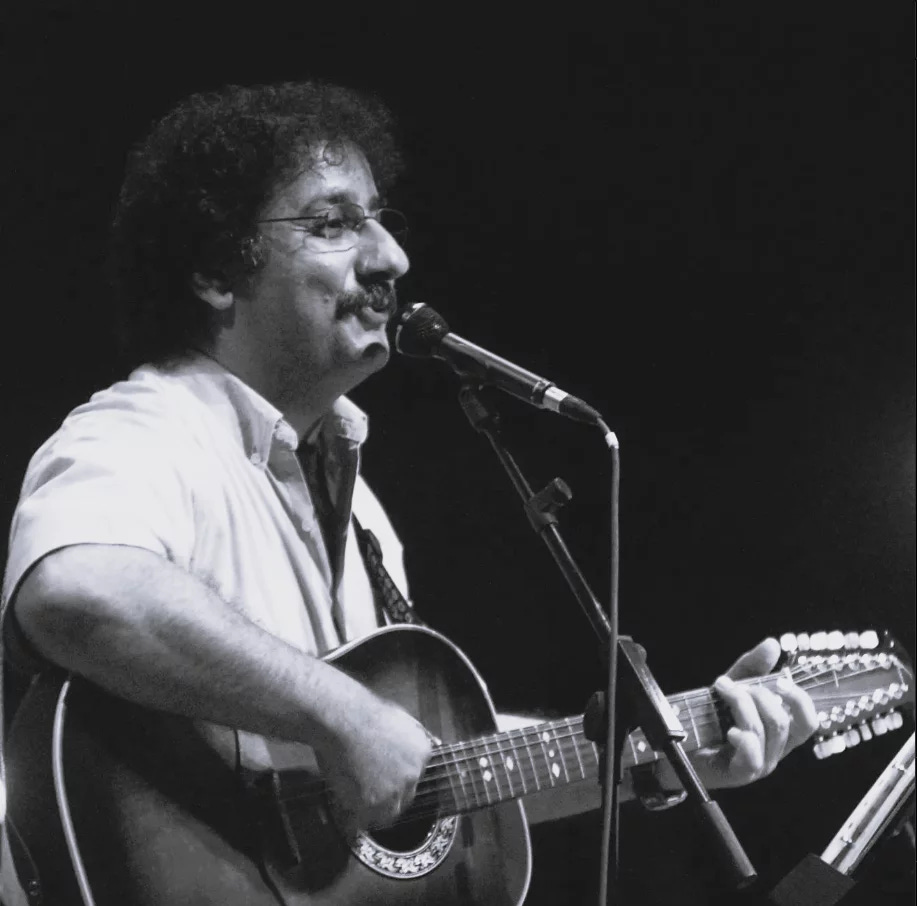
Khaled El Haber is a popular Lebanese musician with a musical career spanning many decades starting in the 1970s. He sings and composes in a variety of styles, most notably in folk and jazz. I recently met Khaled at his Beirut home where her shared some of his insights and experiences with me.
How Did You Get Into the World Of Music?
My dad bought me my first guitar at eight or nine years old. I asked my neighbor to tune it for me. My brother first started playing it. The same night, I stayed up all night and created my first song and played it to my parents. My brother later stopped but I continued and eventually had many teachers.
I was born in Msaytbe, next to Sakintel Helou. I was in the Frere School, in front of the abandoned Holiday Inn Hotel. I had a great Russian music teacher, we would discuss music a lot. Eventually when he travelled, I continued on my own. Then at 11-12 years old, I started composing and writing my own music. In Frere there were lots of guitarists. Then when I went to school in Sin el Fil, there were also people who played guitar and we made a band. This was in the early 1970s. At that point, I and Issam Hajali made a band called Rainbow Bridge – named after a Jimi Hendrix album. We used to practice like crazy. We were four band members. Me, Issam, Raymond Sabbah, and Ali Nehmeh. It was really the golden age for guitar and the Lebanese song. Music that was going around was things like the Rahbaniyet, Zaki Nassif, Sheikh Imam, you know, lots of open mindedness. On the other end of the spectrum there were The Beatles, Elton John, Led Zeppelin, The Moody Blues, Om Kalthoum, Sheikh Sayyed Darwiche, and then Bossa Nova. When the war had started. Chico was the only person who used to get Brazilian music and sell it. We used to listen to the likes of Gilberto, Astrud, Jobim – we didn’t have a problem with any kind of music really. This is what made this amalgam with us. For example, Issam was heavily influenced by Bossa Nova – as well as Ziad [Rahbani]. In 1975, I went into the army, and I asked if I could bring my guitar. There was another guy who also played – we teamed up as a duo and used to play in the barracks. That was where I first sang Kafarkela and Aytaroun. Eventually, people enjoyed it, and started asking me to teach their kids guitar and all kinds of things.
Oh yeah, before I went to the army, I got a scholarship to study music in Russia, but I didn’t end up going. So I continued music on my own – I started getting very involved in it. I started finding my fan base growing. That’s when I knew this was my path. There was a lot of criticism. People were telling me all kinds of things like to go sing in San Francisco. At the same time I was surrounded by people who loved this kind of music. Once I was asked to play a concert in Sour. They said it was a venue that fit a 100 or 200 people maximum. When I arrived, there were about 1500 or 2000 people. I arrived with eight songs and just my guitar, and no band. I asked myself, “What am I gonna play for all those people?” So I sang my eight songs twice, and the people were happy! Afterwards, I had worked with a few musicians and created a band. Then we started playing concerts. We used to play 2-3 times a week.
What Were Some of Your Musical Influences?
All kinds. Folk had a really big influence on me. Georges Moustaki, Léo Ferré. Gilbert Bécaud, Jacques Brelle. These guys really influenced me. They sang poems. There were also the Beatles and Pink Floyd – who were really something amazing. But my main influences were Lebanese – Fairuz, the Rahbani brothers, Zaki Nassif, Toufic el Bacha.
How Did You Enter the World Of Politics?
I am from a leftist family. My parents met in the Lebanese Communist Party. They were not even from the same sect. It’s not that my father actively tried to make me a leftist. I was inspired from the books at home, my parents, friends, their kindness, and their humanity. The first time I applied to the party I was fifteen years old. They didn’t accept me at the time. So I joined the Democratic Youth League and stayed for a few years. And that’s where I met my eventual wife. It was the kind of environment which pushed me to fight for humanity, dignity, and against unfairness, pain, and poverty. Then I joined the Communist Party and lasted a year or two, because I couldn’t stay in the meetings which lasted for six or seven hours! I’d rather focus on my work. I’m still a Communist myself now – perhaps more so than many who claim to be. But in my current position, I am more effective.
What About the Palestinian Cause?
We were raised with the Palestinian cause. In 1967, I was ten years old. In that event, I felt like I lost something dear to me. I’d always heard about what the Israelis did. There was no resistance at the time and I opposed the Israeli oppression to Lebanon and towards the whole region. The first song I ever wrote in English, and nobody knows this, when I was twelve, was called, “A Girl from Palestine” – I don’t remember anything from it.
I Noticed You Admired Mahmoud Darwiche, Tawfic Ziad, and Samih Qasim. Why Was That Exactly?
I used to read Mahmoud Darwiche since I was about fifteen years old. These three were our main inspirations. We related to Mahmoud the most because he was the most musical and rhythmic. I have worked with all of them, but not as much as others have. Even the way we wrote at that time was close to how they wrote. Oghniya Ela Sa’eh Mutajawel, Ela Habibati 3ala Sabeel lt Tatmeen. They also influenced us technically. I used to write in formal Arabic, and then eventually I changed to colloquial – it was closer to people.
You Also Wrote Your Own Music?
We were one of the very few who wrote our own music. For example, Ziad rarely ever used work from anybody else, he always wrote his own music. I wrote about 90% of my own work as well.
Have You Ever Thought About Leaving Lebanon?
In 1976 I went to Paris. They told us to take part in a festival that happens every year. So we went. Me, Marcel Khalife, and Elia Saba (of Ferkat al Ard) and they asked us to make a band, do a few shows in Paris, and come back. It was then where we created Ferkat Al Mayadeen, which now play with Marcel Khalife. But I couldn’t stay there. I stayed for three months. I had to come back and did so by ship. And funny enough, the day after I got back, they opened the airport! Later, we went to Paris and lived there for about five years.
Eventually, our work is for this country. Our target is these people here in Lebanon. I‘ve toured Europe and half the world, and have come across the Arab diaspora, and if you really believe in your cause, you must stay here no matter what the cost. People still criticize me, but am I going to sing to French people about Lebanon? Plus, I don’t sing “oriental” music for them to consider me exotic, my work is made for these people that I live with. I like to deal with Lebanese people as people.
What About Your Children?
I have two sons. Ramzi is doing his Master’s degree in Political Science in Spain. Rayane is working in music. He writes, composes, and is really helping me out in the music world. He does his own original compositions, his arrangements, my arrangements, management, and works with the instruments.
How did you meet Ziad Rahbani?
In 1976, The National Democratic movement took over the Official Lebanese Broadcasting station and they asked me to come and record a few songs. I recorded four or five songs there. One day I was there, they told me that Ziad crossed over from East Beirut. At that point, Ziad had surprised everybody. It was an achievement for somebody to be able to cross – they could’ve easily killed him. So, a common friend introduced us. I asked if he was interested in hearing what I had recorded and so he did, and he really liked it and thought it was great. But I was going to Paris the next day. He said it’s okay, we’ll collaborate soon, and that night we stayed over at a friend’s house and have remained close friends since then. When I got back, we lived together and even worked at a resto-pub called Pizza e Vino. We worked there for seven months every night. Him on the piano and me on the guitar. After seven months we asked ourselves, “what are we doing?” We weren’t making any money, and the money we did make was spent on our friends!
What About Your Collaboration, Ahmad Zaatar?
At that point, Tal el Zaatar had taken place and Mahmoud Darwiche had released Ahmad Zaatar. I composed it and I asked if he would arrange it. He said of course, and eventually locked himself in his house for a month and came up with what you know as the arrangements to the track. But we were living together at the time, and we’re still great friends today. We don’t just relate in terms of music, but also in terms of politics. All the political choices we took, we took together, and they ended up in the same direction.
Was The Album Where You Collaborated Famous?
Yes, that one was pretty famous. The least popular one was Ahmad Zaatar. People didn’t feel like waiting twenty minutes to listen to it.
Is The Story of the Famous Lebanese song, Sobhi El Jeez, Based on a Real Event?
No, no it isn’t. This was a song Ziad created for a play that never saw the light of day. It was meant to be the finale. He asked me if I would sing it, I said sure. There were no musicians in the country so I played drums and he played double bass on the track. He started marking the bass neck with pencil so he could know the notes. And eventually I played guitar and he played piano.
Yes I Always Noticed That The Bass Fumbles Halfway Through!
Yeah, he didn’t know how to play bass! There weren’t any musicians around and even if there were, we didn’t have any money to pay them!
-
This interview was originally published in AUB Outlook on April 11, 2016.