

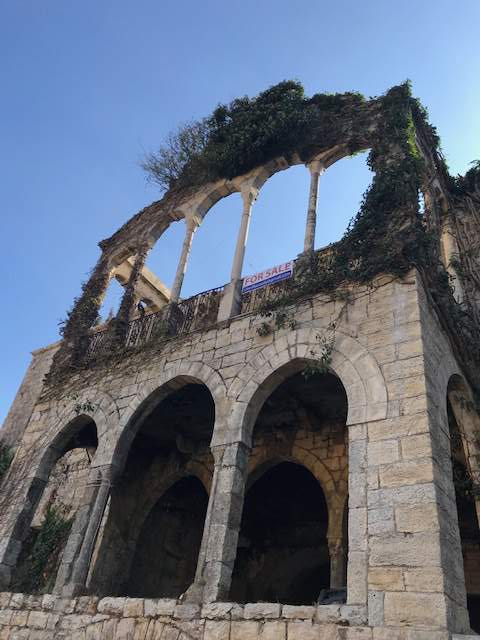
Tucked into a Mediterranean coastal town, a historic Lebanese house pediment was recently rescued from near collapse. Composed of five arches supporting a stone pediment, the structure had deteriorated after decades of abandonment. Ironically, what held it together in its final years were climbing plants whose roots had woven themselves through the columns and masonry, acting as an improvised brace.
The house was constructed at the turn of the twentieth century and underwent renovation in 1974. That intervention proved short-lived. Following the outbreak of the Lebanese Civil War in April 1975, the property was abandoned and left to the elements. It had belonged to Jamil Baroody, a prominent Lebanese diplomat who served as Saudi Arabia’s representative to the United Nations from the organization’s inaugural session in 1946 until 1979.
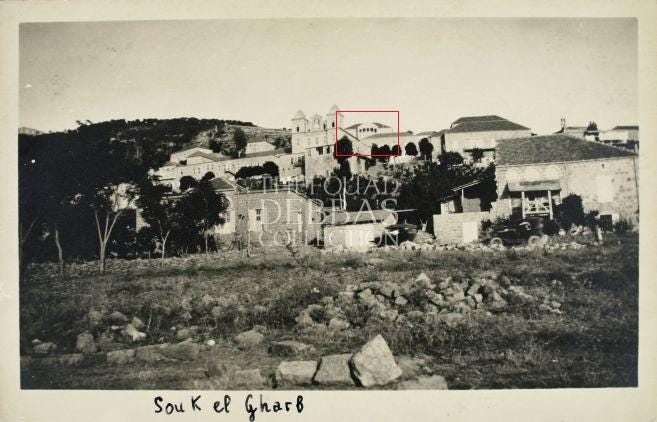
By 2019, the pediment’s condition had become a cause for alarm. Fearing imminent failure, Jamil Baroody’s nephew, Hiram Corm, initiated a restoration effort. Owing to the structure’s historical status, the project was subject to close scrutiny by local authorities and required a carefully considered approach. The objective was twofold: to stabilize and restore the pediment, and to introduce a pitched roof that would protect the house below from environmental exposure.
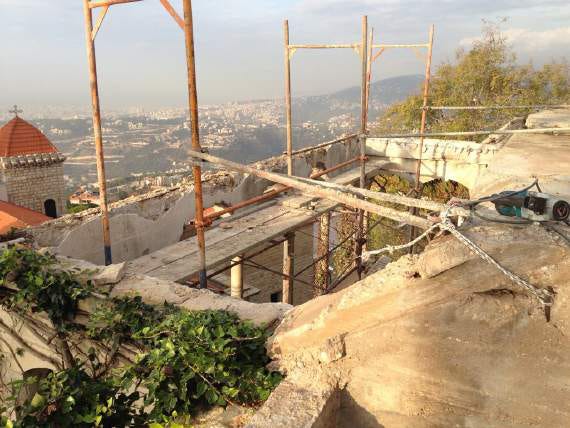
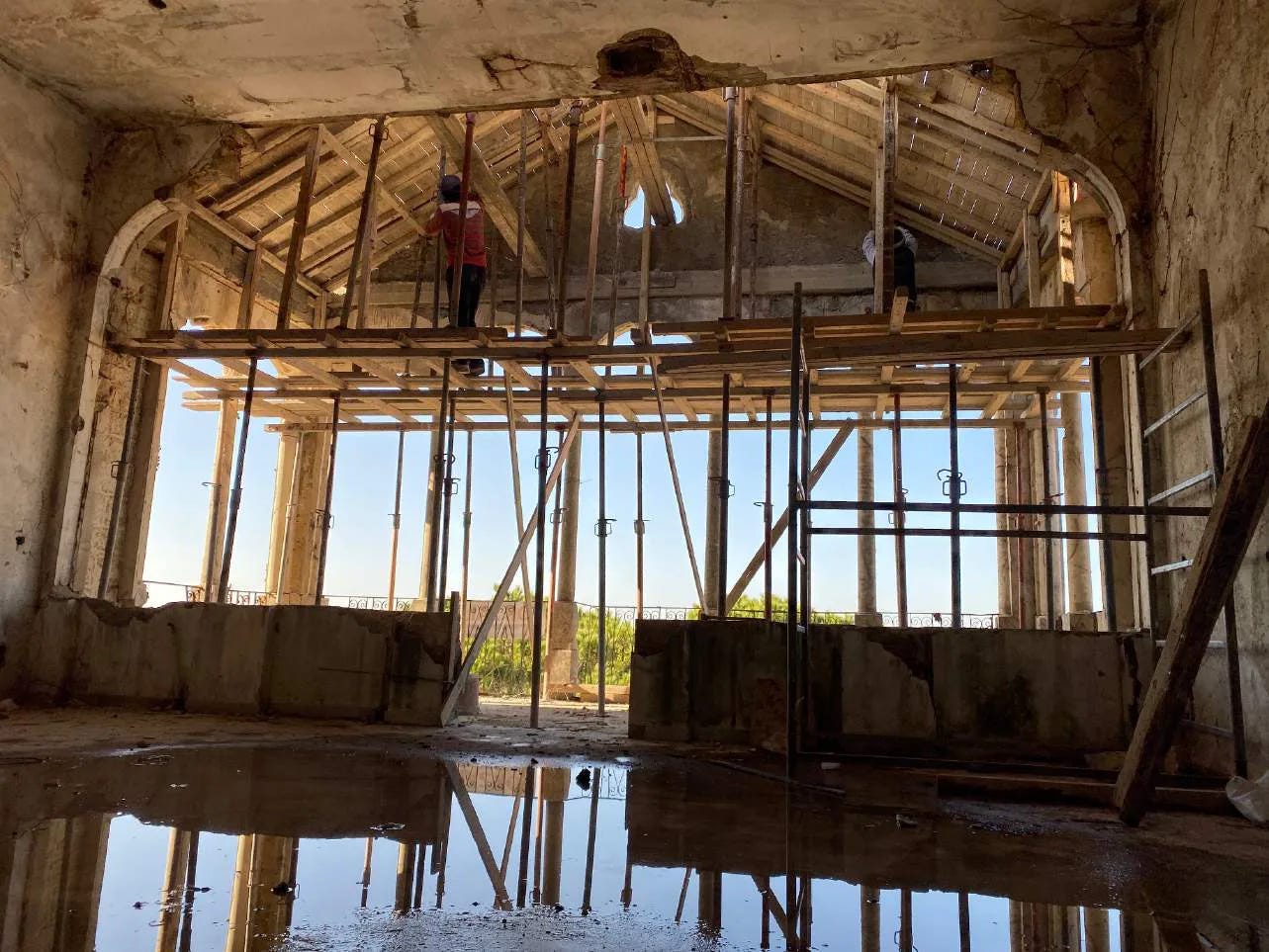
The intervention began with the careful dismantling of the pediment, each stone individually catalogued and numbered. The arches were then repositioned and leveled. Above them, the first course of brickwork was cut vertically in two, with the interior half removed. Within this concealed cavity, steel reinforcement and wooden formwork were installed to create a concrete tie-belt capable of supporting the pediment. Concrete was poured, forming a structural spine that left the exterior brickwork visually untouched while providing substantial internal reinforcement.
Once the concrete had cured, the pediment was reconstructed precisely as it had stood before. A new pitched roof was then added, reinforced with steel and cast in concrete, completing the restoration.
When the work concluded, a municipal employee reflected on the project: “Souk al-Gharb was in an uproar when the pediment was dismantled. We feared the house was being demolished to make way for something new. When we realized it was being strengthened and rebuilt, we rejoiced!”
-
This article was originally published in Civil + Structural Engineer Magazine on July 14, 2024.