


Dia al-Azzawi, born in Baghdad in 1939, is one of the most celebrated Iraqi artists of the modern era — an artist whose work spans painting, sculpture, printmaking, and artist’s books, and whose voice has shaped the discourse of modern Arab art for more than half a century. Deeply rooted in Iraqi cultural heritage yet profoundly engaged with global artistic currents, Azzawi’s work reflects both personal and collective histories marked by memory, loss, conflict, and resilience.
From Archaeology to Artistic Vision
Azzawi’s early life in Baghdad laid the foundation for his lifelong exploration of cultural memory. After completing a BSc in Archaeology at the University of Baghdad in 1962, he went on to earn a Fine Arts diploma from the Institute of Fine Arts in Baghdad in 1964. His dual grounding in ancient history and contemporary art equipped him with a unique visual language: one that would merge the symbols of Mesopotamian antiquity with the expressive possibilities of modernism.
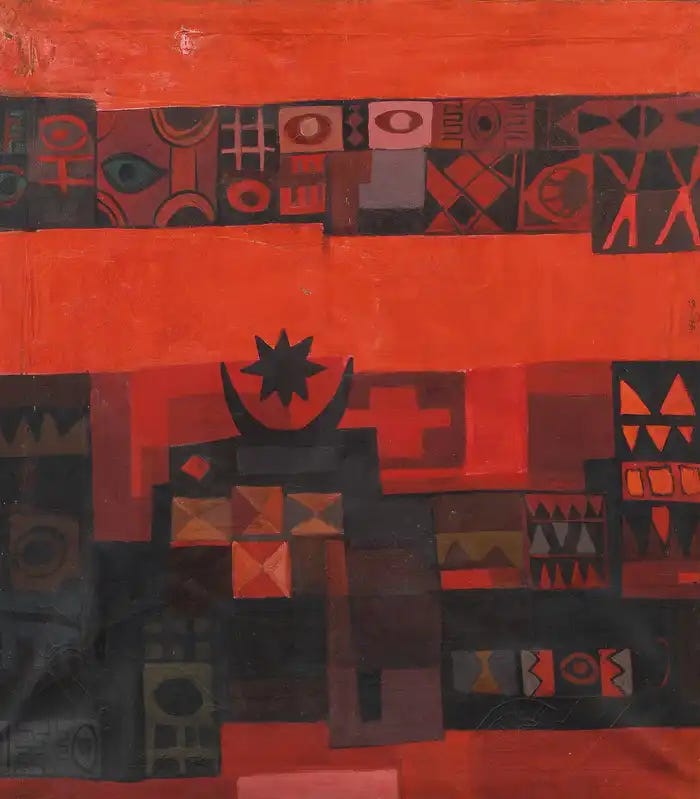
This synthesis is visible from his earliest works, where mythological and folkloric references stand alongside bold experimentation. One notable early painting, A Wolf Howls: Memories of a Poet (1968), created in the aftermath of regional upheavals including the Six-Day War, combines geometric abstraction with motifs inspired by Iraqi kilim rugs and an unpublished poem—an early testament to his interest in blending text, image, and cultural roots.

A Leader in Iraqi Art Movements
In 1969, Azzawi co-founded the New Vision (al-Ru’yya al-Jadidah) group alongside a generation of Iraqi artists. Unlike earlier art movements that focused primarily on stylistic experimentation, New Vision argued for art that was both critically engaged and culturally rooted, encouraging artists to address contemporary realities through forms inspired by local traditions. Azzawi also briefly joined Shakir Hassan Al-Said’s One Dimension group, reflecting a vibrant artistic scene in Baghdad that sought new visual vocabularies inclusive of calligraphy, abstraction, and narrative.
From 1968 to 1976, he served as director of Iraq’s Department of Antiquities, a role that further deepened his engagement with the country’s rich historical legacy. During this period, he also helped organize cultural initiatives such as the al-Wasiti Festival (1972) and the earliest Arab art biennials (from 1974), positioning himself as both creator and cultural organizer.

Exile and Expansion of Practice
Political repression in Iraq in the 1970s led Azzawi to relocate to London in 1976, where he settled and continued to develop his eclectic practice. In London, he became an advisor to the Iraqi Cultural Centre, promoting Iraqi and Arab art across Europe and beyond. His work expanded into dafatir(handmade artist’s books) and limited-edition print collections based on Arabic literature, interpreting poems by Mahmoud Darwish, Adonis, and other major writers through richly textured, image-text hybrids.
Throughout his career, Azzawi has remained responsive to political and social realities. His monumental mural Sabra and Shatila Massacre (1982–1985) confronts the massacre of Palestinian refugees during the Lebanese Civil War, transforming tragedy into a haunting visual testimony; the work is now part of the Tate Modern’s collection.
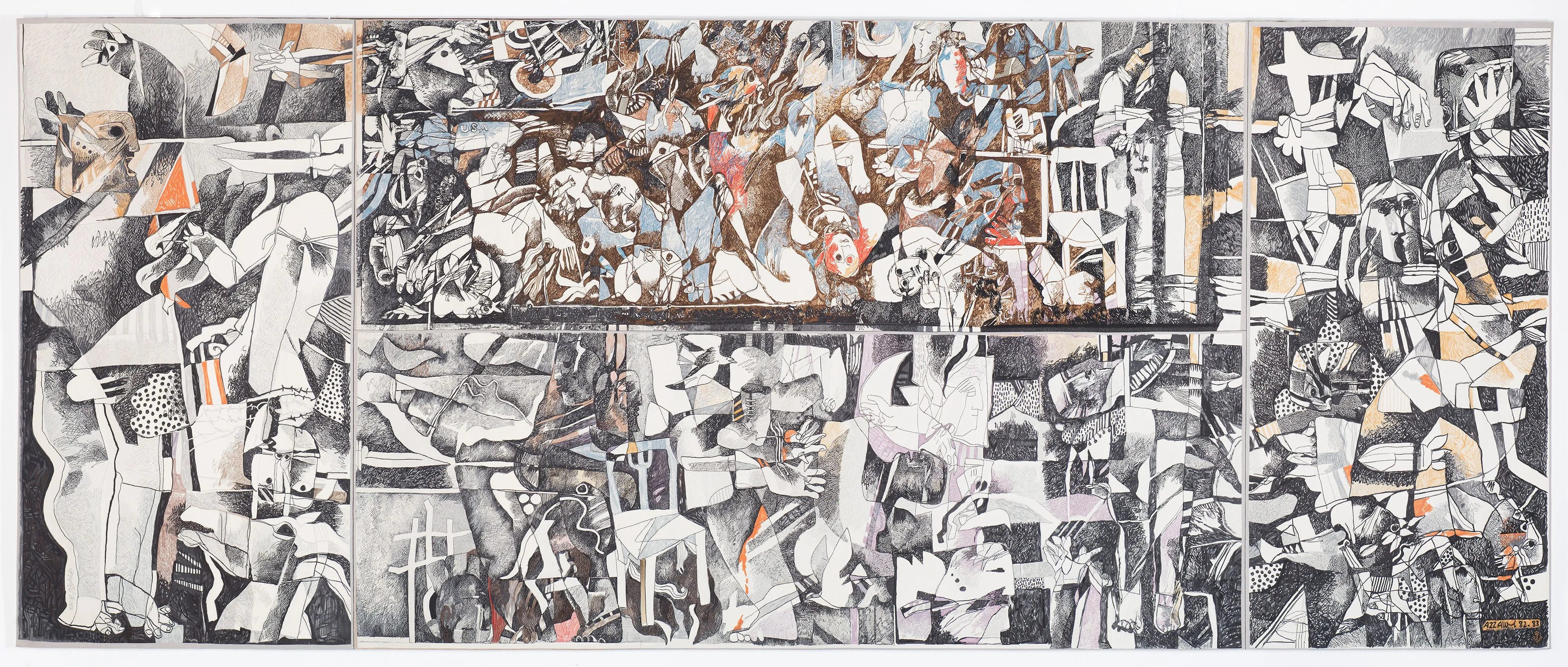
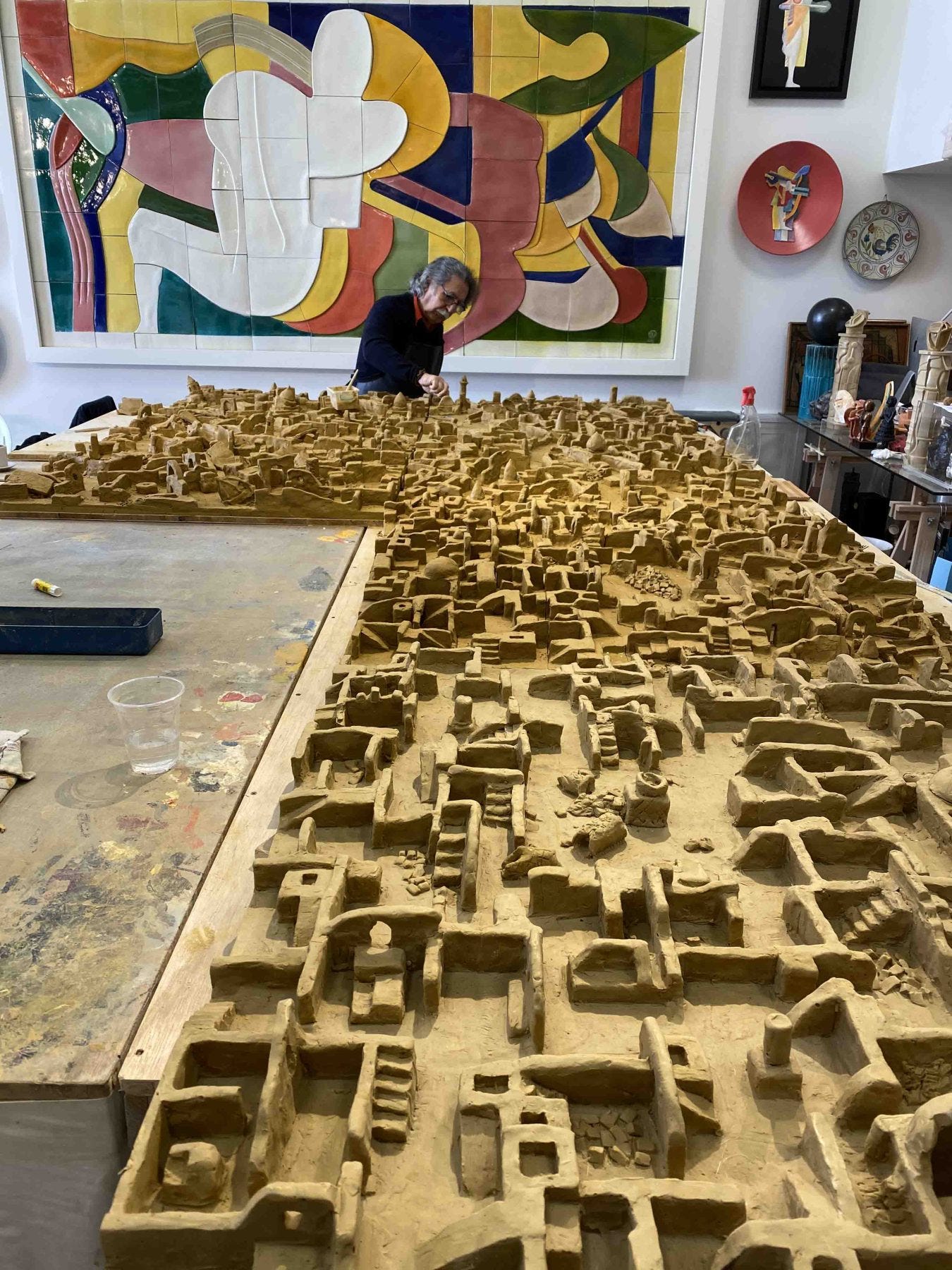
Later works continued to address regional tumult. His panoramic pieces — such as Mission of Destruction (2004–2007), spanning over 15 meters — respond to the 2003 U.S. invasion of Iraq and its aftermath, visualizing fragmentation, loss, and the erasure of cultural heritage. Charcoal series like Nights of Extermination extend this engagement, reflecting on the destruction of historic cities and the ongoing turmoil across the Arab world.

Global Presence, Local Resonance
Azzawi’s work has been exhibited widely and is held in major museums and collections worldwide, including the British Museum, Institut du Monde Arabe (Paris), Mathaf: Arab Museum of Modern Art (Doha), and the Library of Congress (Washington, D.C.). His art also featured in prestigious events like the Venice Biennale and numerous international exhibitions, exposing global audiences to his singular blend of expressive form and cultural commentary.
Despite decades in exile, Azzawi continues to cultivate connections with the Arab world. He supports emerging artists, sponsors cultural projects, and collaborates on publications dedicated to modern art in West Asia and North Africa. Awards such as the Dia al-Azzawi Prize for Public Art (Tamayyouz Excellence Award) and recent international honors underscore his enduring influence.
An Enduring Legacy
Dia al-Azzawi’s work transcends chronological and geographic boundaries. It is at once deeply Iraqi and broadly universal, invoking the shared experience of displacement, memory, and the search for identity. Through his art, Azzawi not only chronicles history but invites us into a space where past and present converse, reminding us that art can be both witness and catalyst in times of upheaval.